How to keep a friendship alive when you’re both busy (without trying harder)

Open the thread with your friend and look at the date on the last message.
For many people, it is further back than they expect. Not because anything happened. There was no argument, no decision to drift apart, no moment either of you could point to.
You meant to reply. Then the week did what weeks do.
Now enough time has passed that a message feels like it needs to be a big one, and a big one takes energy you do not have on a Tuesday night, so you keep not sending it.
Nobody dropped the ball here. There was no ball.
The friendship did not fade. The container did.
Think about how you two used to see each other.
There was probably a structure holding it up. The same office, the same class, the same neighborhood, the same weekly thing you both went to anyway.
It put you in each other’s path without either of you deciding anything.
Then one of you moved, or changed jobs, or had a kid, and the structure went away.
The affection did not go anywhere. The structure did.
What looks like a busy season is often a friendship that lost its container and has been running on individual willpower ever since. Willpower is a terrible material for anything you want to last, because it is the first thing a hard month takes.
Maintenance is not the same as trying harder
Most advice here tells you the same three things: reach out more, be more intentional, make time. All of it asks the tired person to produce more energy, which is the one thing they do not have.
The friendships that survive busy years are often not the ones with the most effort in them. They are the ones that ask for the least before contact can happen.
That is a design question, not a character question. And design is the part you can actually change.
Five ways to make a friendship easier to keep warm
Lower what counts as contact.
A voice note counts. So does a photo with no caption, or an article sent without explanation. None of it requires a reply, a plan, or a good mood, and all of it keeps the thread warm enough that the next real conversation does not have to start from cold.
The goal is not depth every time. It is not starting over.
Say the true thing instead of the apology.
The instinct after a long gap is to lead with how bad you have been at this. It feels like taking responsibility, and it quietly hands the other person a job.
Name the gap without asking them to carry it: “I thought about you today and realized how long it has been. I miss you.”
Nothing to absolve, nothing to answer. Just the true thing.
Attach it to something that already repeats.
You already do something on a schedule. A regular errand, a Saturday walk, the twenty minutes waiting outside a school.
Put the friendship inside one of those rather than carving out something new. A new commitment competes with your whole life. An existing one barely notices the company.
Trade repeated maybes for one standing plan.
Several maybes cost more coordination than one certainty.
A standing monthly call can outlast a year of good intentions, even when it gets skipped, because most months there is less to negotiate and less to arrange.
A plan you do not have to make is the easiest one to keep.
Let it go quiet without immediately deciding it is over.
A quiet stretch does not automatically mean the friendship has ended. Say the one true thing, then let their answer tell you whether the door is open from both sides.
Dormant is a real state, and it is not the same as gone. Some friendships move through several quiet seasons and still come back.
But coming back has to be mutual. You can leave the door open. You cannot be the only one walking through it.
What actually keeps it
All five ideas work for the same reason: they lower the amount of energy a friendship asks from you before contact can happen.
The strongest version is a shared rhythm.
It does not have to be physical. It can be a monthly call, a recurring game, or a Saturday walk. What matters is that neither of you has to invent contact from scratch every time.
And for many friendships, being repeatedly in the same place offers something texting often cannot. It gives conversation somewhere to happen before either of you feels organized enough to schedule it.
The friendships that survive the busiest years often have help. Something outside both people’s moment-to-moment willpower keeps putting them back in contact.
What ours looks like
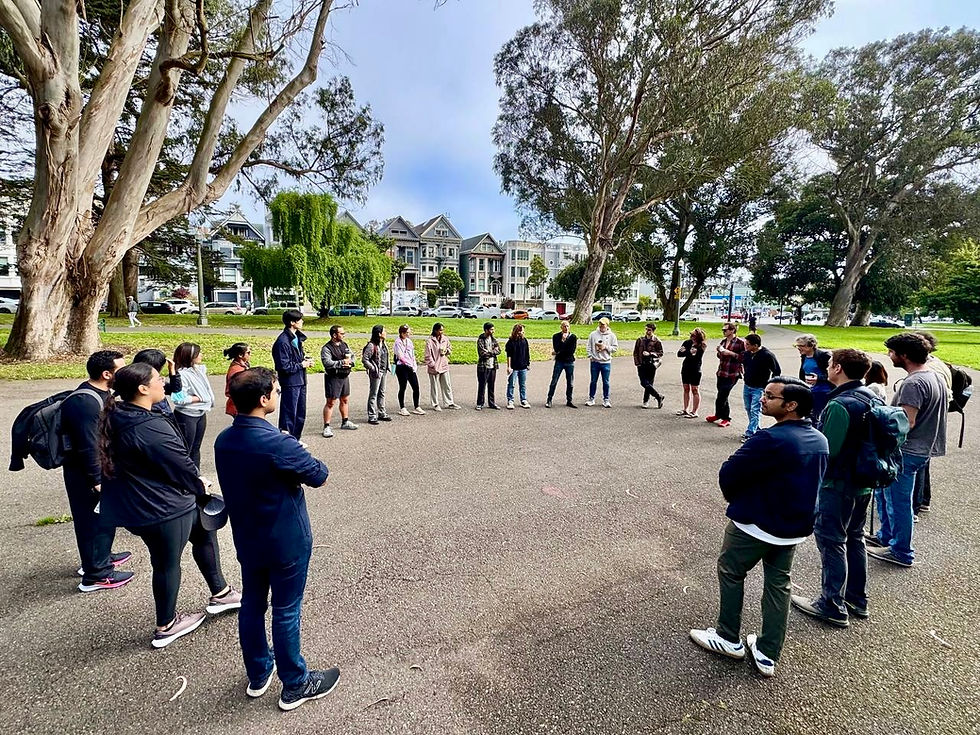
We run a free five-mile walk on Saturday mornings in 20+ cities. Phones stay in pockets. The walk happens whether you come or not, and missing a week never requires an explanation.
Some people bring the friend they have been meaning to catch up with. Two hours of walking beside someone gives them time to actually hear how the other person is doing.
Others arrive alone. Over time, some begin recognizing the same handful of people. Friendship starts happening on a schedule without feeling scheduled.
We believe the loneliness crisis is an environment problem, not a connection problem.
So go back and look at that thread again.
Maybe you do not owe anybody a long explanation. Maybe one true sentence is enough.
And maybe what comes after that is not a better text, but somewhere the two of you can end up again without either of you having to build it.
Cameron Hogan is the co-founder of The Board and host of THE BOARD WALKS in Austin, Texas.