What to do when you have no plans this weekend (and why it keeps happening)

It is Saturday, around eleven.
Nothing is on the calendar. Nothing ever was, technically, but you had assumed something would materialize.
You scroll for a while. You look at the group chat, which is active but not about anything. You think about texting one specific person, and then you run the whole thing forward in your head: the “hey, what are you up to,” the wait, the reply that comes at four. You decide not to.
So you tidy something. You order food. It gets dark at a normal time, and the day is just over.
Here is the part worth saying out loud: that is not a verdict on you.
The empty weekend is a scheduling problem
We treat a blank Saturday as evidence.
“Not social enough.”
“Should have kept up with people.”
“Everyone else is doing something.”
But look at the actual mechanics of your week.
For many people, Monday through Friday arrives with structure. Work does it, school does it, caregiving does it. Something tells you where to be without asking you to invent the day from scratch.
Saturday often has no such thing, which means somebody has to decide, text, coordinate, and follow up.
Often, that somebody is you.
An empty weekend is what unstructured time looks like when nothing recurring lives inside it.
Not a personality flaw. An absence of scaffolding.
What actually helps this weekend
Five things, in the order I would try them. None of them requires you to already have plans.
Go where there are regulars, not where there are plans.
There is a difference between going out and going somewhere people return. The farmers market. The same coffee place at the same hour. The branch library. The run club that meets whether four people come or forty.
You are not looking for an event. You are looking for a place where showing up alone is normal and the same faces keep appearing.
Move one ordinary part of your day into public.
Read outside instead of inside. Take the laptop to the counter. Walk the loop instead of using the treadmill.
This may not produce a conversation, and it does not need to. It puts you among other people without requiring a reason or a performance.
Send an invitation that can survive a no.
“I’m walking at two if you want to join” works better than “what are you up to?” because your plan still exists either way.
You are not asking someone else to rescue the day. You are giving them an easy way to enter it.
Decide what you will do before you wait for the answer.
Once you send the text, choose your next move. If nobody answers by one, you are still going to the market, still taking the walk, still leaving the house.
Do not leave the entire day inside someone else’s typing bubble.
Give an imperfect plan one hour.
If something sounds safe but not exciting, you do not have to give it your whole day. Go for an hour. Leave when you want.
You are not committing to a new life. You are giving the day a chance to change.
What actually fixes it
Everything above can help this Saturday. None of it changes next Saturday.
The deeper problem is not that you had no plans. It is that having plans currently requires an act of will, every single week, from scratch.
Effort is an expensive tool for a problem that comes back every week. It runs out, especially when you are tired.
What changes the pattern is one thing that repeats whether or not you organize it.
Not a full calendar. One thing. Same day, same time, happening whether you come or not, with no organizing required from you and no explanation required when you skip a week.
That is a different category from plans. Plans are decisions. A rhythm is somewhere you can return.
Because it repeats, you start recognizing the same people. Not because either of you arranged it, but because you were both there again.
That is how many friendships get enough time to form.
What ours looks like
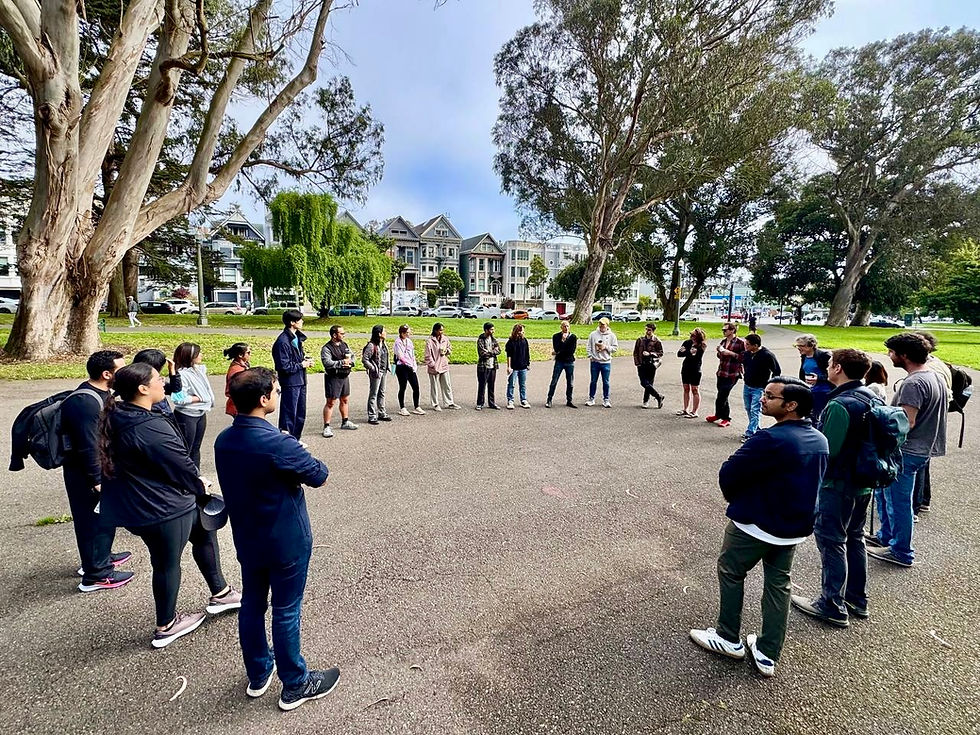
Every Saturday morning, in 20+ cities, people meet at a trailhead and walk five miles together with their phones in their pockets.
It is free, it happens every week, and nobody needs to invite you. Missing one never requires an explanation.
You bring whatever is actually on your mind. You walk beside somebody for two hours, giving the conversation enough time to move beyond small talk. Then some people get breakfast, some people go home, and the following Saturday it happens again.
We believe the loneliness crisis is an environment problem, not a connection problem.
The weekend was never the thing that needed fixing. It was the one part of the week with no rhythm inside it.
Cameron Hogan is the co-founder of The Board and host of THE BOARD WALKS in Austin, Texas.