Why there’s nowhere to just go anymore (and what replaced it)

Think of the last time you wanted to go somewhere and could not think of anywhere to go.
Not somewhere to eat. Not an activity. Somewhere to just be, for an hour, with no reason and no reservation.
Most people run out of options fast. And then, because we are all trained to do this, they decide the problem is them.
“Should get out more.”
“Should have found a spot by now.”
It is not just you. Many of the places that once absorbed an unplanned hour are gone.
The death of the third place
Sociologist Ray Oldenburg gave this a name in his 1989 book The Great Good Place. Home is the first place. Work is the second. Third places are the informal gathering places beyond both: the neighborhood café, the pub, the barbershop, the diner counter, or the corner store where someone knows your order and also knows your brother.
Oldenburg described a fuller set of characteristics. But for the problem we are trying to solve, four functions matter most.
Nobody had to organize their own way in. You could stay for ten minutes or an entire afternoon, and the presence of regulars made chance encounters likely.
You could go alone without being alone, which is a very specific thing fewer places offer now.
What replaced it
Look at where you actually spend unstructured time, and the pattern is hard to miss.
More and more unstructured time comes with a purchase. A coffee shop can still become a third place, but the purchase and the soft time limit change what lingering feels like. More leisure requires a booking or a plan, so spontaneity gets scheduled out of existence.
Even wandering comes through an app now. The app wants you to choose, and choosing is the opposite of wandering in.
Much of our easiest unstructured social time moved online, where you can be surrounded by people all evening and end it feeling like you spoke to no one.
We replaced places with platforms, and platforms are very good at showing us people and very bad at placing us beside them.
This is not nostalgia
Arguments like this usually curdle into “things were better before,” and they were not.
The old third places were often exclusionary in ways we should not romanticize.
The barbershop and the pub were not open to everyone equally. Plenty of people had no third place at all.
The point is not to recreate an idealized version of those old places.
The point is that they were performing a load-bearing social function, and we let many of them disappear without replacing it.
Loneliness becomes less mysterious when you look at it this way. One predictable consequence of removing enough spaces where people gather without coordinating is that individuals are left to make up the difference through willpower.
Same loneliness, two different stories.
“I have no one to see” sounds like a personal failing.
“I have nowhere to go” is a description of infrastructure.
The function, not the building
For our purposes, the function comes down to four things.
It is reliably there, so you do not have to rebuild it every week.
It is inexpensive enough that returning does not require a financial decision every week.
It is open enough that you do not need a personal invitation. And it has regulars, so there is a real chance of recognizing someone without either of you arranging it.
Notice what is not on that list.
A fixed building.
Which means the function of a third place does not have to stay still.
We built a moving one
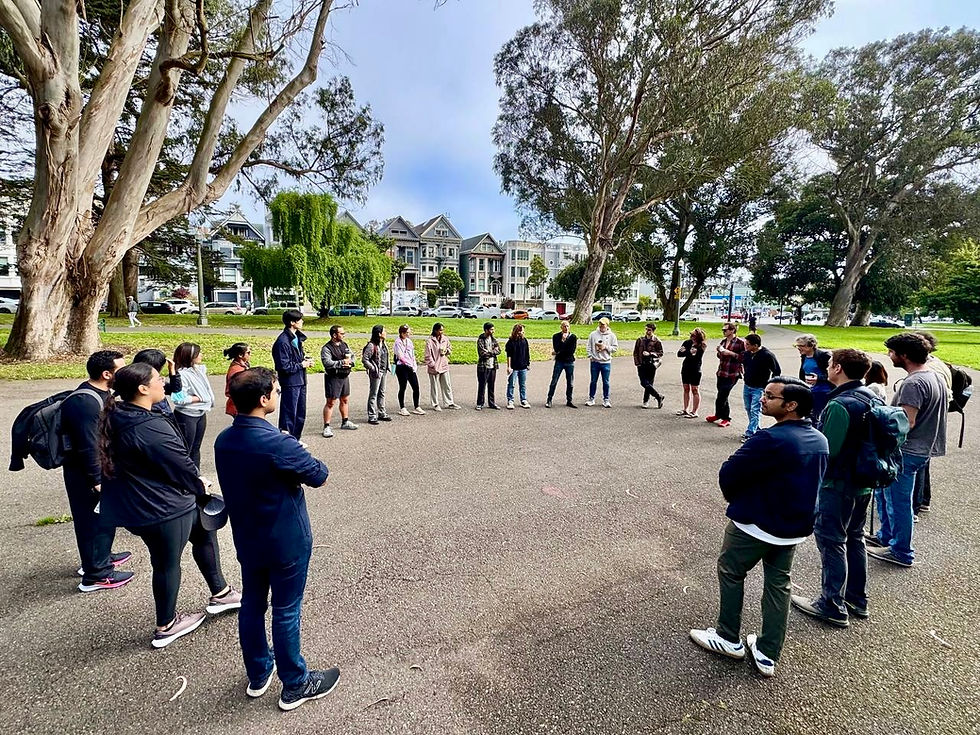
Every Saturday morning, in 20+ cities, people meet at a trailhead and walk five miles together with their phones in their pockets.
It costs nothing. It requires no personal invitation. It happens again the following week whether you come or not. And if you return enough times, strangers begin becoming familiar.
In Aveiro, one Saturday’s walk ended and the group stayed together.
The five miles were over. The gathering was not.
We designed the rhythm. They made it a place.
We believe the loneliness crisis is an environment problem, not a connection problem.
So we built an environment that moves. Same time every week, no agenda, making real connection a weekly habit again.
The next time you want somewhere to go for no reason, there is one. It just happens to be moving.
For the ones who want more than a Saturday
For some people, a Saturday morning is exactly enough.
Others reach the end of the trail and realize they want a smaller room that continues between walks, with people who remember what they are building, ask about it again, and keep showing up.
That is The Board. It is application-only, and it is deliberately small.
Cameron Hogan is the co-founder of The Board and host of The Board Walks in Austin, Texas.